Startup Booted Financial Modeling: The Complete Guide to Managing Cash Flow, Forecasting Revenue, and Building Profitable Bootstrapped Startups
Startup booted financial modeling is an essential tool for founders who are building their business using personal savings and internally generated revenue. Unlike investor-backed companies, bootstrapped startups rely on careful financial planning to maintain operations, grow sustainably, and avoid unnecessary debt. Understanding how to forecast revenue, track expenses, and manage cash flow is critical for success in this environment.
For early-stage founders, startup booted financial modeling provides a roadmap that connects daily operational decisions to long-term financial goals. It allows entrepreneurs to anticipate challenges, plan for uncertainties, and make informed decisions without relying on external capital. By mastering this approach, founders can turn a small investment into a profitable and sustainable business.
Understanding Startup Booted Financial Modeling
Startup booted financial modeling focuses on creating a realistic, data-driven financial plan for startups that rely primarily on internal resources. The goal is to track revenue, control costs, and plan for growth in a way that aligns with limited capital. Unlike traditional financial models, this approach emphasizes sustainability and operational efficiency over rapid expansion funded by external investors.
A key aspect of startup booted financial modeling is understanding the flow of cash within the business. Entrepreneurs must forecast revenue based on real customer data, track operational costs closely, and plan scenarios that account for both challenges and opportunities. This method ensures founders can make proactive decisions that protect their financial runway and maximize profitability.
Key Components of a Bootstrapped Financial Model
Cash runway is a central element of startup booted financial modeling. It measures how long the startup can operate before revenue covers all expenses. This metric is crucial for founders because it allows them to plan investments wisely, allocate resources efficiently, and avoid running out of funds unexpectedly. Maintaining a clear picture of cash flow is the backbone of every bootstrapped financial model.
Revenue forecasting in a bootstrapped startup is often conducted using a bottoms-up approach. This means projecting revenue based on individual sales, customer acquisition metrics, and realistic conversion rates rather than high-level market assumptions. Expense tracking is equally important, covering operational costs, software, personnel, and marketing. Scenario planning is another vital component, helping entrepreneurs prepare conservative, base, and aggressive projections to navigate uncertainty effectively.
Step-by-Step Guide to Building a Bootstrapped Financial Model
The first step in startup booted financial modeling is selecting the right tools. Many founders use Excel or Google Sheets for flexibility and transparency, while some explore specialized software for more advanced calculations. The goal is to build a model that can evolve as the business grows and new data becomes available.
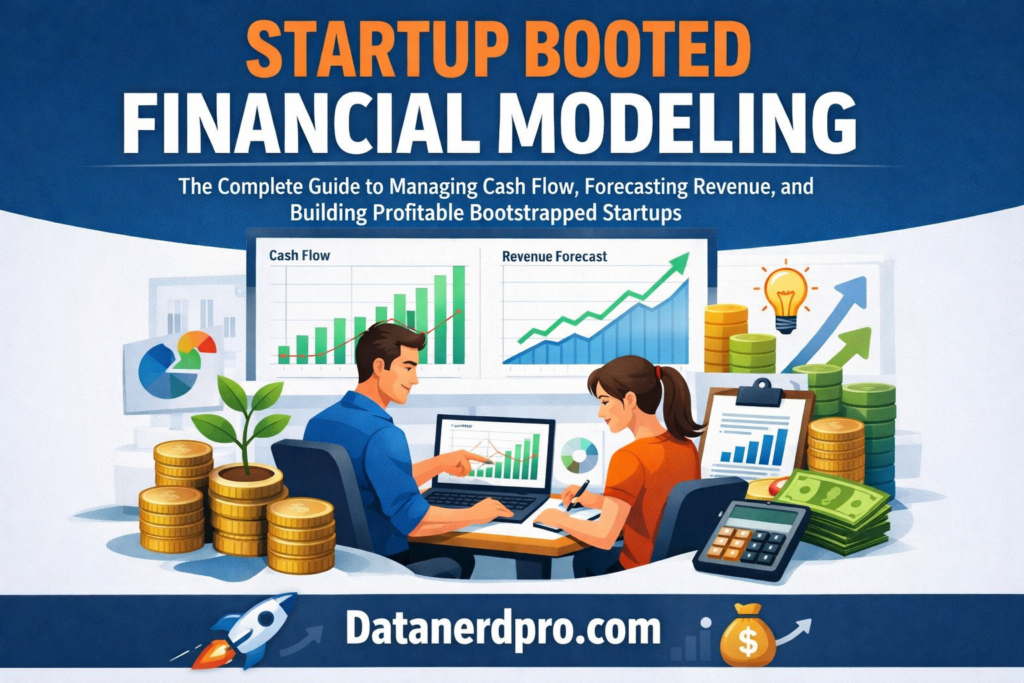
Next, entrepreneurs must project revenue based on real customer behavior. This involves analyzing sales patterns, conversion rates, and recurring revenue opportunities. Expense tracking is also critical. Startups must carefully monitor costs to maintain lean operations while maximizing output. Regularly reviewing cash flow, updating projections, and reinvesting profits strategically ensures the model remains accurate and actionable over time.
Best Practices for Financial Management in Bootstrapped Startups
Profitability should always take priority in startup booted financial modeling. Founders should focus on generating sustainable revenue rather than chasing rapid growth that may drain resources. Lean operations, low overhead, and high-margin products or services are essential to maintaining financial health in a bootstrapped environment.
Aligning financial planning with customer needs is another best practice. Product development, marketing, and operational spending should be guided by real feedback and measurable outcomes. By monitoring key metrics, adjusting strategy, and avoiding common mistakes, founders can maintain control over their financial model and achieve long-term success without relying on external investors.
Tools and Resources for Startup Booted Financial Modeling
Several tools can simplify startup booted financial modeling. Excel and Google Sheets remain popular for their flexibility and accessibility, allowing founders to build customizable models. More advanced software solutions offer automation, scenario analysis, and real-time reporting, making it easier to track complex financial data efficiently.
Additionally, online tutorials, templates, and case studies provide valuable guidance. Learning from successful bootstrapped startups can help entrepreneurs understand how to forecast revenue accurately, manage cash flow, and reinvest profits strategically. These resources empower founders to build effective financial models that support growth and sustainability.
Conclusion
Startup booted financial modeling is a powerful framework that helps founders maintain control over their business finances. By carefully forecasting revenue, tracking expenses, and planning for various scenarios, bootstrapped startups can achieve profitability and long-term sustainability. This approach ensures that every financial decision is informed, strategic, and aligned with the startup’s core goals.
Founders who prioritize accurate financial modeling gain a competitive edge, reduce risks, and create a roadmap for scalable growth. Mastering this skill can transform limited resources into profitable outcomes, proving that careful planning is often more powerful than outside investment.